
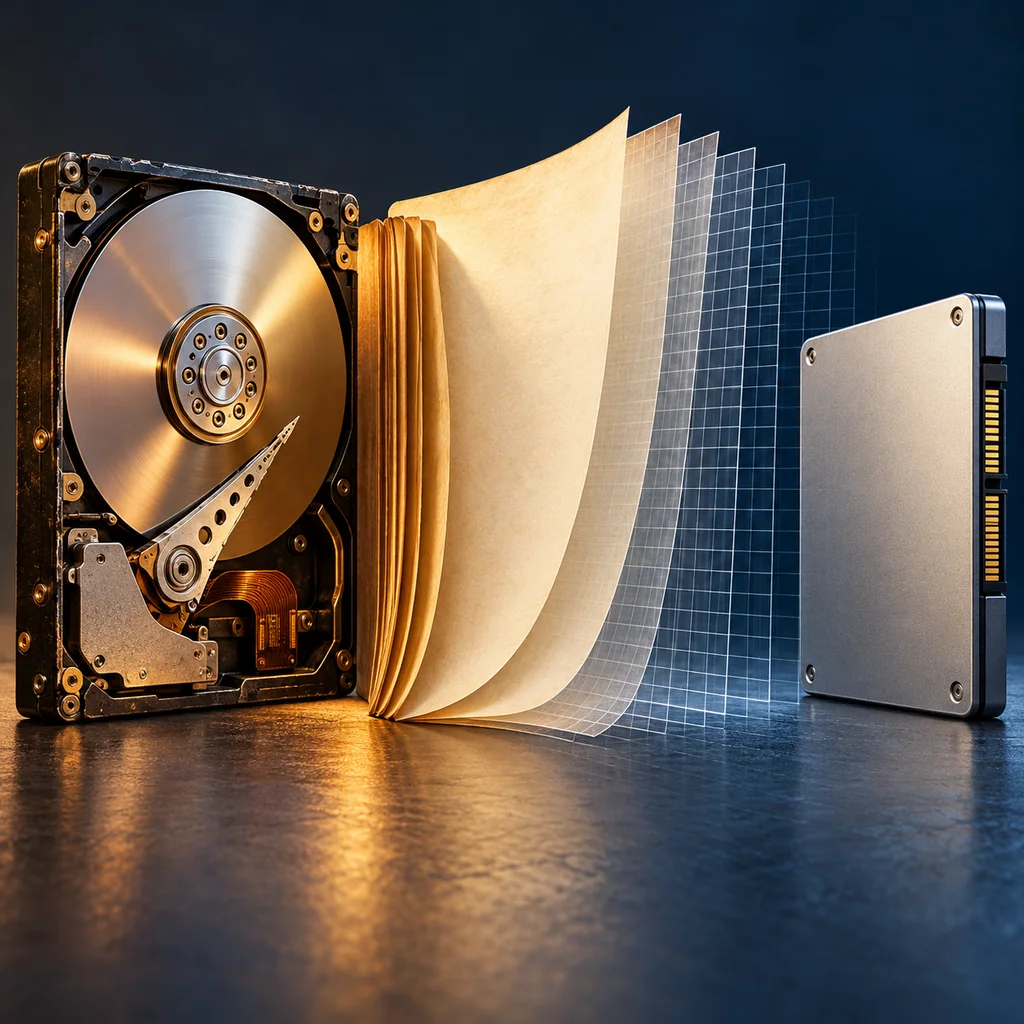
DoD Wipe Labels: Historical Methods and Modern Sanitization
Short answer
“DoD wipe” is not a complete specification for accepting a sanitized drive. Ask which document, edition, procedure and media type the label refers to, then compare that claim with the requirements governing the actual job. A three-pass or seven-pass menu option describes an implementation choice; its name alone establishes neither current authority nor physical coverage.
NIST SP 800-88 Rev. 2 explicitly notes that DoD removed overwriting specifications from NISPOM in 2006. DoD's current issuance directory identifies the former DoD 5220.22-M NISPOM with 32 CFR Part 117. Those facts make an undated “DoD compliant” claim insufficient for a modern acceptance record.
Who this is for
This guide is for authorized storage-processing teams, technical buyers and reviewers evaluating an old wiping requirement or a tool's report. It explains how to audit a claim, not how to select a method for classified material or certify compliance with a contract. The responsible authority must resolve those requirements for the specific job.
What history can safely establish
Separate three layers that are often compressed into one label:
| Layer | What to identify | What it cannot establish by itself |
|---|---|---|
| Historical publication | Issuer, document number, revision and applicable passage | That the same instruction governs today's asset |
| Tool implementation | Exact mode, software version, pass pattern and verification behavior | Official approval, certification or hidden-area coverage |
| Current acceptance requirement | Customer policy, contract, approved procedure and responsible authority | That the tool actually completed the required operation |
The 2006 change is documented in NIST's current discussion of legacy overwrites. DCSA also describes the transition from the NISPOM policy manual to the NISPOM Rule, effective February 24, 2021. Neither fact means a reviewer should substitute a different procedure on a classified job without authorization.
This article deliberately does not reconstruct an exact historical pattern sequence from a software menu or a secondary summary. A claim that a particular sequence was required in an old edition needs the original passage and its media-specific context. If that passage cannot be obtained, mark the historical claim unverified rather than repeating it as a universal standard.
Why pass counts and coverage answer different questions
A pass count says how many overwrite operations a tool attempts under its own definition of the target. Coverage asks which data-bearing locations those operations can reach. Repeating an operation cannot, by repetition alone, establish access to a region outside that operation's scope.
For a host overwrite, distinguish the selected logical addresses from the device's physical storage. For flash storage, controller mapping and spare locations make that distinction especially important. An HDD and an SSD exposing similar block interfaces do not thereby have identical sanitization behavior.
Even a full readback answers a narrower question than many reports imply: did the readable locations return the expected bytes? It does not independently settle inaccessible-location coverage, separate copies, or an unsuitable method. The SSD translation-layer guide develops that distinction without treating flash as a magnetic disk.
When to use this
Use this review when a purchase specification says only “DoD erase,” a report lists a pass count without a revision, or a legacy procedure is being migrated to current policy. Resolve the requirement before scheduling a destructive run, rather than discovering at handoff that the report cannot support the promised claim.
When not to use this
Do not use a general comparison article to downgrade a customer's explicit requirement, change retention obligations, release classified storage, or declare an old record invalid. A dated record may correctly document the requirement and method that applied at that time. Preserve its context.
Workflow
- Copy the exact requirement as received, including its document references and contractual context.
- Identify the asset's medium, model, firmware, interface and intended destination.
- Ask the requirement owner to identify the governing edition and approved technique. Distinguish a historical reference from a current operative instruction.
- Compare the tool's documented behavior with that technique: target scope, completion status, error treatment and required verification.
- Resolve exceptions in writing before execution. Do not silently replace a mode because another option is faster or has more passes.
- After authorized execution, attach evidence to the asset and obtain the required acceptance decision.
The following is an example of a claim-review record, not a completed certificate or a prescribed regulatory form:
received_claim: EXACT WORDING
referenced_document_and_edition: UNRESOLVED UNTIL VERIFIED
applicable_authority_or_requirement_owner: REQUIRED
media_model_firmware_and_scope: REQUIRED
tool_version_and_exact_mode: REQUIRED
documented_behavior_and_coverage_limits: REQUIRED
execution_result_and_exceptions: REQUIRED AFTER EXECUTION
acceptance_decision_and_basis: REQUIRED BEFORE RELEASE
What if a customer still explicitly requests a legacy mode?
Treat the request as a requirement to clarify, not a reason to invent a compliance equivalence. Ask whether the customer intends an exact algorithm, a particular verification procedure, or a sanitization outcome under a named policy. Obtain the approved interpretation and retain it with the job.
If the specified technique cannot provide the necessary coverage on the actual medium, raise that incompatibility before work begins. The resolution might be a revised approved procedure or a different disposition. It is not simply “add more passes” or “rename the result.”
Verification note: reviewing a report rather than claiming a test
No drive was erased for this article. The review criterion is traceability: an assessor should be able to follow the requirement to the identified device, the approved technique, the recorded execution and the acceptance decision. An unsupported standard name should remain an exception, not become a completed checklist item.
Verification checklist
- The document number and edition are explicit where a historical requirement is claimed.
- The selected tool mode has a documented meaning and version.
- The medium and required scope match the procedure's applicability.
- Status, errors and unresolved regions appear in the record.
- The responsible reviewer has accepted the result under the actual requirement.
Resale and evidence checklist
Before external handoff, keep the asset identity, authorized disposition, actual operation and its outcome connected. Describe what the report demonstrates. Do not put “DoD certified” on a resale record merely because a tool offers a similarly named mode.
What not to publish
Keep customer contract details, storage contents, keys and sensitive asset identifiers in the approved internal system. Public examples can show the record's fields without exposing the data being removed.
Common mistakes
Avoid treating a vendor label as an issuing authority, mixing different historical editions, or assuming the largest pass count is the strongest method for every medium. A newer policy reference is also not evidence that its required operation ran successfully.
CliDeck workflow fit
The useful workflow is a durable link between requirement, asset and evidence. This article does not establish any CliDeck product's wiping modes, certification or supported media. Evaluate product capabilities separately from the historical label.
FAQ
Is a seven-pass option automatically a current DoD requirement?
No. Identify the governing instruction and its applicability. The number displayed by software is not enough.
Can an old report still be meaningful?
Yes, if its date, requirement, asset scope and actual execution are clear. Historical evidence and current acceptance are different questions.
Related guides
The NIST Revision 2 process guide explains verification and validation. The HDD sampling analysis explains why a passing sample cannot prove that no data remains anywhere on a drive.
Safety note: This guidance applies only to devices your team owns or is authorized to process. Use the approved, device-specific procedure, customer policy, and your organization’s sanitization and evidence procedures.