
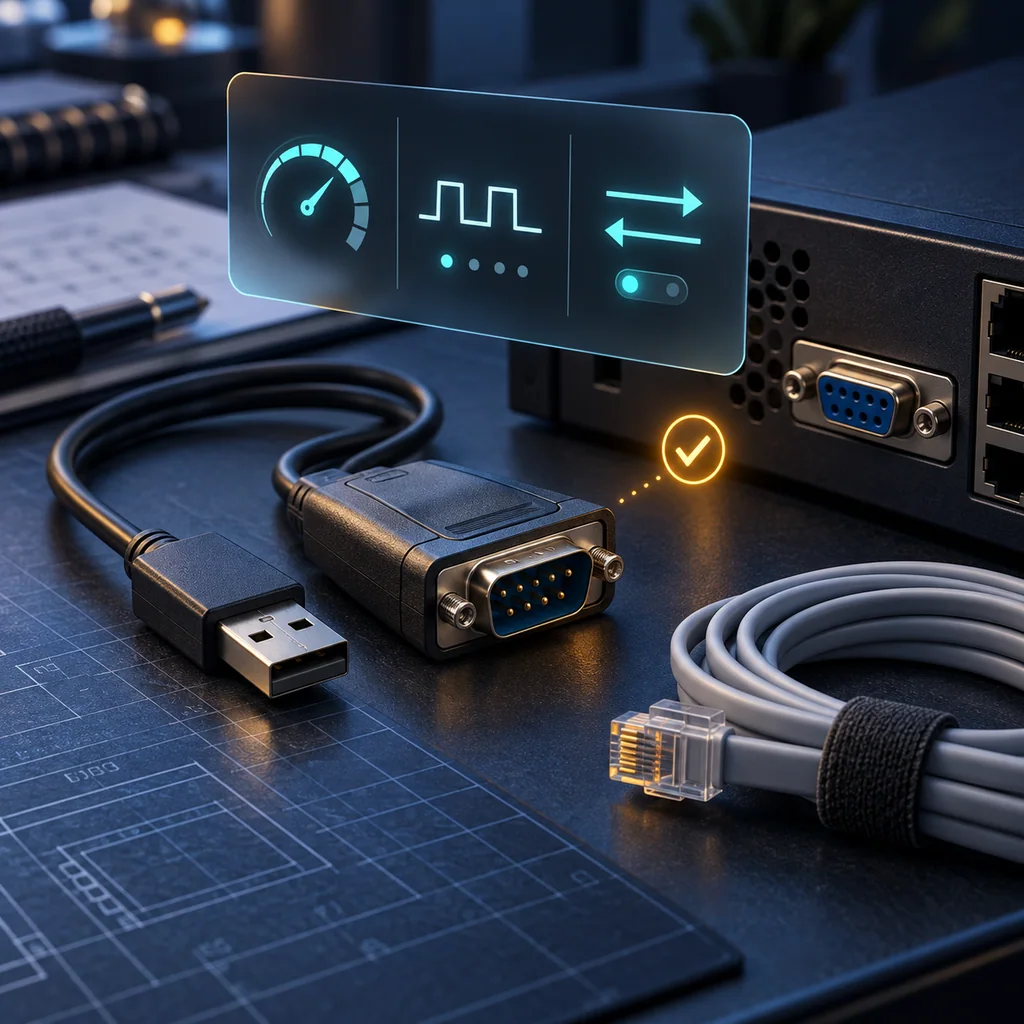
Linux Serial Settings: Inspect stty Without Guessing the Console Profile
Short answer
Use GNU stty's display options to inspect a specifically identified Linux serial device, then compare the reported settings with the appliance's documented console profile. An inspection of host settings is not a measurement of the appliance's baud rate or proof that a later terminal session will use the same settings.
The scope is Ubuntu 24.04 LTS with GNU coreutils 9.4 tooling. Device access must be authorized and coordinated. Although the commands below do not request a termios settings change, opening and closing a serial device can affect modem-control lines. Do not probe an occupied production console as if inspection were electrically invisible.
Confirm the adapter and the session owner
Identify the exact USB adapter and its serial-side appliance before opening its device node. Do not rely on a remembered ttyUSB number. Check for an existing terminal session and coordinate with its owner using the separate serial-port ownership procedure.
If another operator is working on the port, use that application's visible settings or arrange an approved pause. Do not kill the application to collect a prettier baseline.
Record the intended console profile from documentation for the actual appliance and build: speed, data bits, parity, stop bits and flow control. “Usually 9600 8N1” is not an adequate device-specific requirement.
Identify the workstation tool
The following command reports the utility version without opening the serial device:
stty --version
Keep the version with the workstation record. The --file syntax below is GNU syntax; this article does not provide a portable command for every operating system.
Avoid running plain stty -a and assuming it describes the serial adapter. Without a device selector, stty uses standard input, which can be the shell's own terminal rather than the appliance console.
Inspect the selected device explicitly
Only after the ownership and device-open impact checks, replace /dev/ttyUSB0 with the observed node:
stty --file=/dev/ttyUSB0 --all
This form requests a human-readable display. Preserve the complete output and collection time, then extract the fields needed for the comparison.
A leading minus on a flag indicates its disabled form. Read the related flags together rather than treating every word as a setting to apply:
- Speed describes the host's reported serial speed.
- cs8 indicates eight data bits.
- -parenb indicates parity generation/checking is disabled.
- For the common eight-bit framing case, -cstopb corresponds to one stop bit; cstopb selects two.
- crtscts concerns hardware RTS/CTS flow control.
- ixon and ixoff concern software flow-control behavior in different directions.
An eight-bit, no-parity, one-stop-bit combination describes framing. It does not select the correct speed or settle the flow-control requirement. Preserve those as separate comparisons.
Understand what the snapshot cannot prove
A terminal program may apply its own profile when it opens the port. Settings collected before that program starts therefore do not guarantee the program's active session settings. Check the application's actual selected profile through its supported interface as part of the connection procedure.
Some adapters and drivers do not support every requested speed or control behavior. The display is host-side state, not an electrical measurement of timing on the wire.
Hangup behavior also matters. With HUPCL, modem-control lines can be lowered when the last process closes the device. Whether an attached appliance reacts depends on the cable, adapter and appliance. Do not claim a harmless open/close cycle without understanding that combination.
Handle failures without changing the device
For permission denied, confirm the approved access path; do not make the device world-writable. For an absent node, return to adapter identification. For an unsupported terminal or ioctl error, preserve the error and investigate the driver and device type.
Do not append a baud value, raw, sane or framing flags to the display command. Those operands can request settings changes. A missing field or an unfamiliar speed needs a documented investigation, not an automatic default profile.
Do not use output redirection to the device node as a way to save the result. That would send bytes toward the serial connection. Save any authorized transcript to an ordinary private workstation file through the normal evidence workflow.
Verification note: criteria for a settings inspection
An acceptable record identifies the exact adapter and appliance, establishes session ownership, records GNU stty's version and full selected-device output, and compares the host snapshot with documented requirements. The terminal application's eventual active profile needs its own confirmation.
These are acceptance criteria, not a tested adapter result. No actual serial opening, line transition or appliance communication is claimed. Unknown modem-control effects and occupied sessions are stop conditions.
Use Linux adapter identity checks before choosing a node, and serial-port ownership checks before disturbing a session. Keep the approved profile and evidence in the CliDeck workspace.
Who this is for
This guide is for network engineers, field technicians, remote hands, lab engineers, and system administrators who need to connect to, troubleshoot, log, or verify a serial console session on switches, routers, firewalls, appliances, servers, and other devices with console ports.
When to use this
Use this guide when:
- You need direct console access to a switch, router, firewall, appliance, server, or lab device.
- SSH or management-plane access is unavailable, unreliable, or not yet configured.
- You need to troubleshoot a USB serial adapter, COM port, baud rate, or terminal session.
When not to use this
Do not use this guide when:
- Do not use this guide as a substitute for vendor documentation, site policy, or a verified device-specific runbook when the operation is risky.
- Do not continue if the console output suggests you are connected to the wrong device.
Quick checklist
- Identify the device and console connector
- Use the correct console cable or adapter
- Find the correct serial port or COM port
- Start with the expected baud rate and 8N1 settings
- Press Enter to confirm the prompt
- If output is unreadable, check baud rate and line settings
- If the port will not open, check permissions, drivers, and whether another program is holding the port
- Save useful session notes or logs when the work matters
Traditional cable vs CliDeck workflow
A traditional USB serial cable is still the simplest option for quick local work. CliDeck becomes useful when the console session needs browser access, notes, runbooks, sharing, logs, remote hands support, or a portable controller workflow.
Console Server Go can work like a wired USB serial adapter when connected by USB, but it also adds SSH Console on SSH-enabled firmware builds, browser Workspace, live sharing, 24h+ battery operation, OLED status, and magnetic rack mounting.
Practical runbook format
A runbook does not need to be a complex script. For many operations, it can be a plain command list with notes, expected output, stop conditions, verification steps, and rollback instructions.
What to include
- Purpose
- When to use it
- When not to use it
- Target system or device
- Access path
- Read-only checks
- Change steps
- Expected output
- Stop conditions
- Rollback steps
- Verification steps
- Handoff notes
- Final summary format
Workflow
- Identify the device, connector, cable, adapter, and host operating system.
- Find the correct serial port or COM port and confirm permissions or drivers.
- Open the session with the expected baud rate and line settings, usually 8N1 unless documented otherwise.
- Press Enter and verify the prompt before running commands.
- Save notes or logs when the session supports a change, recovery, handoff, or evidence workflow.
Verification checklist
- The detected serial port or COM port matches the connected adapter.
- Baud rate, data bits, parity, stop bits, and flow control match the device expectation.
- The terminal shows a readable prompt after pressing Enter.
- No other terminal application is holding the port.
- Useful notes or logs are saved when the work matters.
Common mistakes
- Using the wrong cable or adapter for the console connector.
- Opening the wrong COM port or
/dev/cu.*device. - Assuming unreadable output means hardware failure before checking baud rate and 8N1 settings.
- Leaving another terminal application attached to the port.
CliDeck workflow fit
A traditional USB serial cable is still the simplest option for quick local work. CliDeck becomes useful when the console session needs browser access, notes, runbooks, sharing, logs, remote hands support, or a portable controller workflow.
Console Server Go can work like a wired USB serial adapter when connected by USB, but it also adds SSH Console on SSH-enabled firmware builds, browser Workspace, live sharing, 24h+ battery operation, OLED status, and magnetic rack mounting.
FAQ
Is a USB serial cable still enough?
Yes, for simple local work where one engineer is sitting next to one device. CliDeck is more useful when the console session needs sharing, runbooks, browser Workspace, remote hands support, logs, or longer operational context.
What should I check first when serial output looks like garbage?
Check the baud rate, data bits, parity, stop bits, flow control, cable type, and whether the device is actually using the expected console port.
Can CliDeck help with serial console work?
Yes. CliDeck Workspace helps organize terminal sessions, notes, runbooks, and logs. Console Server Go adds portable rack-side access, and Net Controller supports larger batch workflows.
Related guides
- Linux Serial Adapter Identity: by-id vs by-path Before Reconnecting - Compare Linux USB serial by-id and by-path links, inspect udev properties, and resolve the intended adapter before reconnecting a console.
- Linux Serial Port Busy: Identify the Owner Before Disconnecting - Identify the process occupying a Linux serial device, release only the intended session, and verify access without killing unrelated processes.
- Cisco Catalyst MAC Tables: Trace a VLAN Without Guessing the Endpoint - Inspect Catalyst MAC entries by VLAN and port, preserve entry types and aging context, and avoid confusing a learned path with endpoint identity.
- FortiGate Routing Table Checks: Find the Route Without Claiming Packet Success - Inspect the FortiGate IPv4 routing table in the right VDOM and VRF, preserve route fields, and separate routing state from actual packet success.
- Cisco IOS XE Terminal Pagination: Capture Complete Console Transcripts - Remove IOS XE page pauses for one session, capture complete command output, inspect long lines, and restore the original terminal settings.